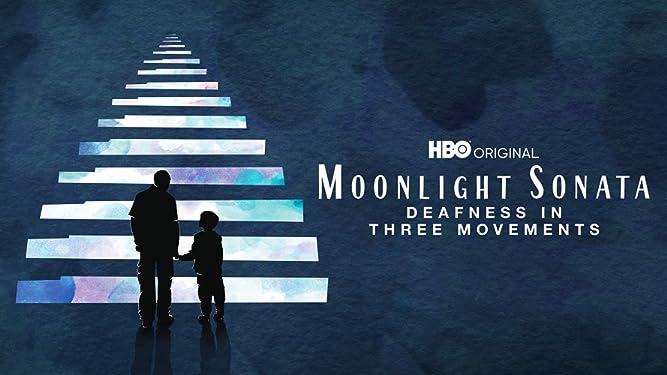
“When my son Jonas was born, doctors told me he could hear,” Irene Taylor, a hearing filmmaker, narrates at the beginning of her documentary film Moonlight Sonata. This first sentence hints that something is wrong, that while he might have been hearing at birth, this didn’t last. This foreboding tone continues throughout much of the film, as we see Jonas struggling to play Beethoven’s “Moonlight Sonata” and we learn more about Taylor’s family, particularly her parents.
As the “First Movement” of the film begins, Taylor explains that, “Around the time he should have been learning to talk, Jonas’ voice was the first clue.” Home video footage shows Jonas babbling, as many toddlers do. Along with this, Taylor splices in videos of wind chimes and underwater rumbles. Distracting the audience in this way seems to be an attempt to communicate that Jonas’ loss of hearing is the result of some dark force seeking to distract him from the world of the hearing.
Many scenes feature Jonas taking various hearing tests. Rather than highlighting a cultural perspective of deafness, these scenes narrow in on an outdated view, the medical or pathological perspective. The sad tone with which Taylor delivers each line of narration implies that deafness is some kind of tragedy. She says, “Every month we would get a new hearing test. Sound was slipping away. Letters, entire words were disappearing.” The whole situation might have been as sad as Taylor makes it out to be, if it weren’t for the fact that American Sign Language (ASL) exists. The truth is, for hearing parents with Deaf children, every opportunity exists to communicate with their child. Rather than the typical progression, though, in which a child gradually picks up on their parents’ language, and grows to meet the language proficiency of their parents, those hearing parents must learn the language which is most accessible for their Deaf child. In the United States, that language is ASL. Unfortunately, use of ASL throughout the film is rare, and it becomes clear that Jonas learning to play a piano piece is more important to his parents than him knowing the language which would connect him to the Deaf community. This linguistic and cultural deprivation is a form of audism, which is the belief, often unconsciously held, that the ability to hear makes one superior to those with hearing loss.
The errors of this film are predictable for media created by the hearing about Deaf people and the Deaf world. The idea that being Deaf is a tragedy and the lack of awareness regarding ASL and Deaf culture are hallmarks of the popular hearing perspective on deafness. What is shocking about this film is the filmmaker’s identity. The woman behind the camera, filming her son taking hearing tests and learning to play the piano, was no stranger to the Deaf community before having a Deaf child. Irene Taylor is a CODA—a Child of a Deaf Adult. In fact, both of her parents are Deaf. Her father, Paul Taylor, was a successful engineer and a pioneer in the development of telecommunications for Deaf and Hard of Hearing Americans. Taylor’s earlier documentary, Hear and Now, told the story of her parents, Paul and Sally, undergoing cochlear implant surgery, and the anticlimactic results. Rather than leaping up for joy, as many of the hearing assume someone would greet an entirely new sense, they find that in many ways, they must learn to hear. Taylor explains in this film, “Their brains were so shaped by a lifetime of silence, that when they finally heard sound, it turned out not to be that meaningful.” Unfortunately, it seems the only thing this experience impressed upon Taylor was the idea that Deaf people simply need to receive cochlear implants earlier on in life.
“I learned from my parents, it would take a lot of work to learn how to hear,” Taylor admits. “But Jonas had an advantage: he was young.” And, it seems, in order to focus on Jonas “learning to hear” and learning to speak English, she neglects to teach him ASL. In scenes in which both Jonas and his grandparents appear, it’s clear that Jonas only has a rudimentary understanding of ASL. This would be heartbreaking if he was hearing, considering his grandparents are Deaf and his mother, as a CODA, is most likely proficient in ASL. As a Deaf child, though, he is being deprived not only of more direct and meaningful communication with his grandparents, but of the language that was made for him, and the community to which he belongs.
While I hesitate to attempt to analyze the motivation behind Taylor’s condescending view of the Deaf community, a few things point to a possible explanation. Near the beginning of the film, she says of her parents, “They gave us things they couldn’t enjoy. Music lessons, record players, movies. In return, we were their interpreters. We were their ears.” This brings up a common issue CODAs face: the need to be interpreters for their parents. Some CODAs express that it feels like they must grow up a little sooner than hearing peers born to hearing parents. This attitude may have led Taylor to believe her parents would be better off with cochlear implants, that they would be more equipped to take care of themselves, not requiring interpreters. Then, when she herself had a Deaf son, she still believed cochlear implants and speech therapy would “cure” him of this need to depend on others for interpreting. Taylor expresses a paternalistic attitude toward Jonas likely because those attitudes had been with her long before she had him.
About halfway through the film, Jonas’ strict piano teacher, Colleen, tells him something about the piece he’s learning to play on the piano. She says, “There are moments that are almost sacred to me.” This idea that there are individual measures of an instrumental piece that are sacred is truly something you would not hear anyone but a piano teacher say. It makes me think, though, about the way so many hearing parents of Deaf children look down on ASL. It is as if, to some of the hearing, the spoken word is sacred in some way that signed words are not. Spoken languages are placed on a pedestal in the minds of many of the hearing. Hearing parents of Deaf children may deny their child is Deaf, deny their need for ASL, and neglect to provide them access to ASL. Then, they get them cochlear implants, and hire speech pathologists to spend hours with their child “fixing” their voice. For the most part, this is rooted in the desire of able-bodied parents to have able-bodied children. Not because they want what is best for their children, but because they want what is expected, comfortable, and relatable for themselves. Soccer-playing parents want soccer-playing children; flutist parents want flutist children. It is not spoken language that is sacred to the hearing, it is the able, healthy body that is sacred to abled people.
The one redeemable aspect of this movie was what Jonas’ grandparents have to say. As they’re sitting at a table playing a card game, Paul tells Jonas, “Make lots of friends, and when you meet them, tell them who you are. Tell them you have a little trouble hearing. But I’m sure they’ll understand you better than they did when I was your age.” Paul says, “Tell them who you are,” then “Tell them you have trouble hearing,” because despite Jonas’ cochlear implants and strong ability to communicate in English, his grandfather’s focus is on the Deaf identity and its importance. Sally, Jonas’ grandmother, encourages him to focus on conversation rather than his phone when he is with friends. “You don’t know what we go through,” she says. “Sometimes you talk to us as if we can hear you.” These short scenes let us in on the perspective of Paul and Sally. In their advice to Jonas, we get a glimpse of their own experience of the world.
By the end of the movie, it seems Taylor believes she can pander to hearing audiences all she likes, as long as she wraps it up in a redeeming bow of vague positivity. She says, “Even though deafness passed through my family’s genes, I never really thought of deafness as a medical condition. It just shaped who we were.” Considering the rest of the film, this lone affirming sentiment falls flat. And that’s not where it ends. Before the credits roll, she speaks wistfully: We gave Jonas hearing, but he had to find his voice. If deafness is a mutation, a typo in our human condition, then our mistakes can become our music.” This references a doctor’s visit in which Taylor’s mother, Sally, learns of the genetic variant that caused her deafness. The doctor, who is hearing, explains how it all works, using the word typo to describe the difference in the genetic frequency. Sally’s face shows she takes issue with this terminology, and says, “It’s a typo?” narrowing her eyes and smiling as if she knows a secret the doctor doesn’t. The doctor nods and says, “Yes, it is a genetic variant, a mutation.” Sally corrects the doctor, “It is what it is,” stressing that for her, it’s not a tragedy, it’s just part of her life, and part of who she is.
This film would be the last one I would show a hearing friend to educate them on Deaf culture. It’s disappointing that Irene Taylor would create a film like this and that more attention was not devoted to the perspective of Taylor’s grandparents. It is essential that we resist narratives told by abled people about disabled people, and focus our attention on media created by those with lived, personal experience in the topics at hand.
Note: This essay was originally written as a film analysis for a Deaf culture class. I’ve edited it significantly to provide more context and changed a few things since I wrote it over six months ago. To learn more about the Deaf world and experience, consider reading Mean Little Deaf Queer by Terry Galloway or Deaf Utopia by Nyle DiMarco. If, throughout this essay, my wording of “the hearing” with the definite article “the” seemed odd to you, hopefully you’ll understand why many consider it odd to refer to Deaf people as “the Deaf.”

 levipierpont.com