
Before this year, my only language learning experience had to do with studying American Sign Language. I’m conversationally comfortable with ASL, one-on-one, thanks to many ASL classes and patient Deaf friends. At the end of 2022, though, I decided to start learning Tagalog, basically the most spoken Philippine language and the main language of the Filipino diaspora. It was the language I heard the most at the time apart from English, at birthday and holiday gatherings, and I was getting tired of sitting quietly and pretending to follow along with the conversation. My YouTube algorithm had caught on to my budding interest in language-learning, and so I began to watch videos by Lindie Botes and other down-to-earth, thoughtful YouTubers who speak several languages and have self-studied some or all of them.
I love setting goals for the new year, so as January 1st inched closer, I crafted a plan to study Tagalog for “at least 16 weeks” of 2023. I thought, if the motivation wears off by week 10, maybe I can set it aside and come back to it, and still reach 16 weeks by the end of the year. Well, Tagalog went on to become my most successful, longest-sustained hyperfixation. My goal, going in, was just to comprehend Tagalog enough to follow along with everyday group conversations, and I got most of the way there in 5-6 months! I also learned that there are many, many milestones to reach after reaching that one. For example, I can read and write texts easily about everyday subjects, running errands, meeting up, etc. I can also use it as a “secret language” in public, depending on the subject. However, I really struggle with reading the books in Tagalog that I’ve purchased, since the vocabulary is a lot broader. Most Filipinos, especially those below a certain age, are quite fluent in English, so English gets mixed into the Philippine languages, such as Tagalog, in regular conversation and in movies, but not always in the news and in books. So, I keep studying, but I’m really happy about how far I’ve come.
Because of learning Tagalog and studying language learning as a concept practically as many hours as I’ve studied languages, I feel like I’ve learned a lot about language acquisition. Today, I want to share this with those of you who have not been blasted with this kind of content by your YouTube algorithm, in the hopes that you may be inspired to begin learning a language in 2024.
Whether or not you can learn a language has less to do with how old you are and everything to do with how much time you have and how motivated you are.
I used to think I was too old to learn a language just because I’m not a child anymore. That’s silly, of course, but it’s just as silly to believe you’re too old to learn a language if you’re 40, 50, 60, or 70. If you don’t have children, If you have some free time and you’re highly motivated, you can learn a language. If you’re one of those weirdos who can do things with any amount of consistency, rumor has it you can learn a language in as little as 15 minutes every day, because you can just stick to it for as many months or years as is necessary. What a wild thought!
You don’t need formal classes, and even if you take classes, self-study as well!
I also used to think, since I learned American Sign Language from skilled teachers, that I could only learn a language if I took formal classes for it. I assumed this largely because it’s difficult for me to maintain consistency without strong accountability. While I do think ASL would be a difficult language to self-study, I now prefer self-study over formal classes. If you have a boatload or even a good-sized storage unit’s worth of motivation, and access to the internet, you can self-study a lot of languages at a faster pace than they’ll teach them in university.
If you’d like to comprehend the language by day one hundred, don’t speak from day one.
A lot of language programs boast that you’ll be “speaking from day one.” Just don’t. Of course if it makes sense to practice by speaking with friends or tutors, go for it. I did that with Tagalog. But focus most of your energy, especially early on, on comprehension.
Learning a language is one of those situations in which you must consciously learn a lot of things you hope to remember unconsciously.
If you have to try really hard to commit something to memory, it’s just not time for you to learn it. The goal is to be able to effortlessly speak and comprehend your target language, so learning should feel effortless. That doesn’t mean it will be easy! But the difficulty lies in setting aside time for it, and sitting down to study, or immerse in the language when you’d rather watch something in your native language. The actual study shouldn’t feel too difficult. This is not a “No pain, no gain,” situation. (Very few situations are, really.)
Do everything.
Do Mango and Duolingo and listen to the podcasts and the news in your target language and change your phone to your target language and watch Netflix in your target language and make language exchange friends and set up tutoring sessions on Italki and do Anki flashcards and watch Bluey in your target language and create Quizlet decks you never use and watch YouTubers who speak your target language while on your lunch break and watch grammar instruction videos from native speakers and read graphic novels in your target language and listen to music in your target language and translate the lyrics to your favorite song and realize it’s actually about an awful tragedy that happened at a night club in 1996. Do everything! By surrounding yourself with the language, you are reminding your brain, over and over again, that this really matters to you, and you really want to remember it. You are also ensuring that you will hear the same words over and over again from a variety of sources and in a variety of contexts, ultimately helping your brain make sense of it all in a subconscious way.
Don’t do anything (unless you have to).
I was once listening to a religious teacher give a lecture and he said, “Don’t do anything unless you have to.” I find that this makes the most sense to me when I most need to hear it, and it makes a lot of sense to me in the context of language learning.
When I first started learning Tagalog, I was terrified by verb conjugation tables. Below is a chart with literally some of the easiest and most common verb conjugations. Once, in a tutoring session, I almost cried as my tutor coaxed me to practice them. And so, for a while, I avoided them. You know what happened? Later, they became a lot easier, and today, I can conjugate several types of verbs easily and can do a good job pretending I know what I’m doing with other types.
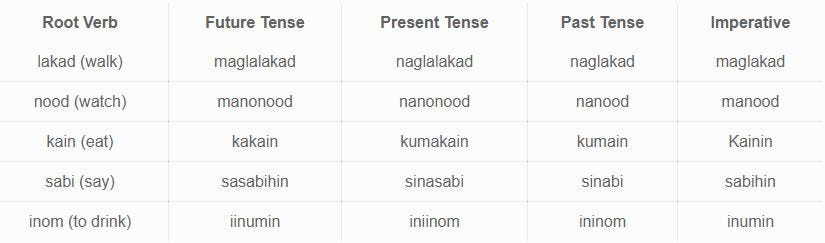
If you feel like avoiding some aspect of a language, do it. And if it’s really all that important, you’ll get so annoyed that you don’t know anything about that aspect, and eventually you’ll be so motivated to tackle it, that it will feel easy when you finally get around to it. That’s the joy of self-directed studying!
Whatever you do,
track your time.
The thing that has kept me motivated the most has been tracking my time. Tracking your time is the easiest way to remind yourself that even if you get bored of it and take a break for a while, when you come back, you won’t be starting from zero. The nearly 600 hours I’ve dedicated to Tagalog this year, mostly in the first six months, represent a chunk of the language that I will never have to re-learn. Even if I don’t study it for a few years, and I come back and feel as if I’ve forgotten everything, it will all still be there, somewhere in my head, and it won’t take me near as long to remember it all as it took me to learn it in the first place. In the future, I want to learn Mandarin Chinese. If I know myself, I know I won’t stick to it for long enough to reach any degree of fluency. But, maybe the second time I get interested, I’ll reach a place I’m satisfied with. Or, if I take it at university, as I’m planning to, the external accountability may keep me going even when that burst of motivation has worn off. For time tracking, I use an app called Timecap, which was interestingly renamed ADHD Organizer, Planner: Focus on the app store.
Conclusion
If you want to study a language in 2024 and want to chat about it, feel free to email me! (levipont@gmail.com) I love encouraging people to study, maintain, or improve the languages they speak or would like to speak, and I’d love to encourage you. Below are my own language-learning plans for the year.
- American Sign Language – Grow my receptive skills by watching and re-watching short videos in ASL, such as those produced by The Daily Moth, with and without English subtitles. (Maintain B2*)
- Tagalog/Filipino – Take advanced Filipino at university! Continue practicing with friends, immerse often, and try to read more. Maintain after the semester ends. (Go from B1 to B2)
- Chinese – Watch lots of content in Chinese and listen to the language at all hours. Begin officially studying at university in Fall 2024. (Reach A1)
- Spanish – Watch shows I’m familiar with, dubbed in Spanish, every day. At some point in the year, begin officially studying with a textbook, flashcards, apps, tutoring, and things of that nature. (Reach A2)

 levipierpont.com