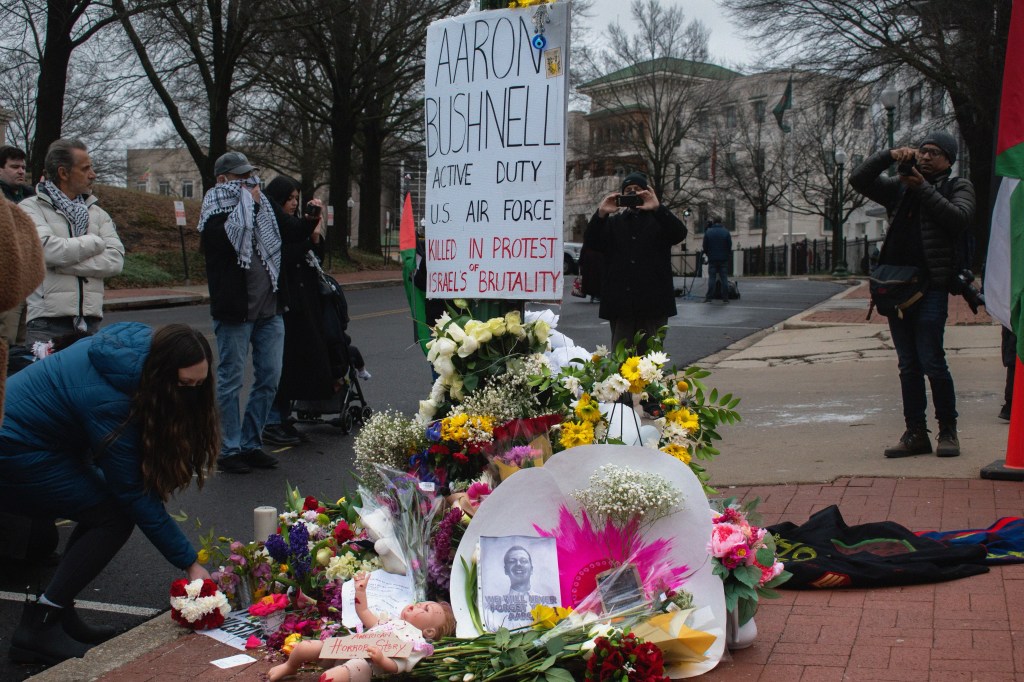
I don’t remember when I first heard about the airman who had set himself on fire outside of the Israeli embassy. All I know is that I knew about it before I knew it was Aaron. And so, I responded to his death at that time with the same callousness with which I had responded to headlines about Israel’s massacres of Palestinians. I told myself that violent and horrific things happened all the time, and there was little I could do. A friend of mine, who did not know I knew him, texted me his name. I didn’t quite believe it until I searched it, and saw his face in all the articles that appeared. In the instant I knew it was Aaron, my heart was broken open, and I felt everything. I understood that my life wasn’t really all that distant from Gaza.
After I called my friend and told her, tearfully, that he’d been my closest friend in basic training, she gently asked if I wanted to know how people were reacting online. “People are posting artwork, people are empathizing with him. Of course, many are making it clear that this is not something people should do, even though they understand why he did it, and hope it will have the impact he wanted.” I told her, “I have to talk to the press.” More clearly than most things, I remember her reply: “You don’t have to do anything.” But I thought I might be one of the people who knew him best outside of his family, and I could imagine that, understandably, they wouldn’t speak to anyone about it. Besides, Aaron and I had talked about global injustice and the American empire countless times over the phone. I admired his intelligence and breadth of knowledge, and understood he knew what he was doing. In other words, I understood what he’d done because I knew a side of Aaron that no one else would get to see if I didn’t share it.
There was likely a second motive, though. When I saw his face on the news, I remembered a conversation we’d had a couple years before. I don’t remember the context, but he brought up Palestine, and I said something like, “None of the countries around [Israel] want them to exist,” parroting a point from my Zionist upbringing which I later learned is the “dangerous neighborhood” trope. He hadn’t talked to me about Palestine in the time since, and I worried it was because of that conversation. I knew I had to stand up for him, and make him real for people who had never met him. It would be too late for him to know, but at least I would be able to forgive myself.
First, I spoke to journalists from the Washington Post, then Democracy Now, then I wrote an essay for The Guardian. As time passed, requests and notes of support slowed down. Through some miracle of kindness, I didn’t receive a single negative message. I spoke to a journalist with New York Magazine, who did a longer story on his life. Each journalist, besides blessed Amy Goodman, pieced together their own explanation for his death, as if his own words were not clear enough. But that’s what people wanted. They wanted to be shown that he cared too much, unnecessarily. If he had a mental illness, they could rest assured knowing (as ostensibly mentally healthy people) that no amount of other people’s suffering could ever cause them to despair, and that even in that unlikely event, they would never have so much compassion that it could consume them. When they discovered he’d grown up in a cult, that was all they needed to hear. “From one extreme to another,” they said to themselves.
Aaron’s death was a wake-up call for people who didn’t want to wake up. So many people came up with tidy explanations for his death, explanations which had as little to do with ourselves as possible, because suicide, and particularly a person self-immolating, is a statement about the living. As Americans, we were all implicated in his statement, and it was devastating to face that. It’s easier to believe we are powerless. Rather than confront the system which forces us to feel like we can only afford to care for ourselves, we loathe those who remind us of it.
As time passes, the more I understand why Aaron chose to die in the way that he did. Yes, I imagine he was hopeless, but it’s clear that he put careful thought into his decision; it was not made on a whim. Yes, his upbringing had an impact on him, but everyone’s upbringing has an impact on them—in contrast to Aaron, however, many of us are raised to be selfish and closed off to the suffering in the world. Aaron grew to disagree with his parents about religious matters, but he was raised believing that there was hope for the world. His parents called it the gospel. Maybe he called it liberation. I imagine that in some ways, studying social justice movements and reading theory felt like building up a new existential framework—an explanation of why we’re here, what’s wrong with the world, and how it can be fixed. You can’t blame a person for believing the world can change.
Last July, I visited a friend from the Air Force who separated around the same time I did. He was one of the most thoughtful and considerate people I’d met at the base where I was stationed. Sitting across from him at a coffee shop in Fargo, I told him about the impact of Aaron’s death on my life and what I’d seen and learned so far in the movement for Palestine. As with any other friend, I hoped to get him involved in some way. He was a photographer, so I imagined he could easily show up to protests and take pictures. But he resisted. At one point, he said, “It’s great that you’re doing this and you’re passionate about it, but not everyone else is—we all have to do what we feel called to.” I felt hurt, and turned his words over and over in my mind afterwards, not sure what angered me so much. I wanted to say, “Yeah, I’m passionate about wanting to stop a genocide, but I guess some people don’t feel called to care about anyone but themselves.”
Now, after the months that followed and much reflection, I realize what bothered me about his comment: the individualism of it. “We all have our passions.” The neoliberal ethos, structured around the supremacy of the individual, erodes collectivism and perpetuates an individualist perspective on social justice. We are not often taught about the behind-the-scenes, collective organizing involved in past movements for social justice. My own education taught me the stories of a few whitewashed, influential leaders, and I learned the lesson: anyone can change the world if they have enough drive, enough courage, enough passion. Whether it was Aaron’s detractors or my own friends, the main idea was the same—if the focus is on the individuals, be they passionate or misguided, then we don’t have to think critically about these problems and our own role in them.
In August, I went to Palestine. I heard stories from parents whose children had been arrested in the middle of the night, and the lawyers who worked to help those children. A man in East Jerusalem who advocated against home demolitions showed us his own home, which the occupation demolished. I met Alice Kisiya, a Palestinian Christian defending her family’s land in Bethlehem. I stood at the border of Gaza and watched military vehicles drive out; I heard the destruction happening. Outright horror gripped me when I considered the Israelis living in the region, going about their everyday lives as this unfolded a short drive away.
The day I left, we stopped in Jericho. The municipality had named a street after Aaron, and I stretched out my hand to touch the sign. On the long journey home, everything I saw began to sink in. I didn’t think I had been naive to the suffering in the world. But on the flights home, my mind raced; some hope within me snapped. The flight from Jordan to Germany was mostly large Jordanian and Palestinian families with screaming children, and I knew they understood what was happening in Palestine. The flight from Germany to DC was different, with hundreds of passengers, mostly American or European. As we flew over the Atlantic, I broke down, thinking, how many people on this flight care that this is happening? How many people even know what’s going on? The apathy, if not cruelty, of the Israelis was clear to me being on the ground, so close to the destruction. I realized, though, that Americans are no better just because we are farther away, because our current system ensures that no place is truly far from the American empire. The terror our wealth is built upon reaches farther and travels faster than our compassion. As most of us have heard many times, this is happening because our money funds it. We build the weapons, and the military industrial complex is at the foundation of our economy. Our political leaders are tyrants, and even the so-called progressives among them rarely criticize the violence of the US and its allies or question our exorbitant defense budget. Processing these things on the final flight from DC to Detroit, I grew numb. I felt hopeless.
Perhaps that was when my last hope for the possibility of reform finally faded. As I returned to university classes that Fall, I began to piece together things I already knew, but didn’t want to admit. When I first became involved in progressive causes, I believed I could make a difference by being an “ally” and “educating myself,” but on its own, that doesn’t change anything. Plenty of people know how broken the world is and they let that knowledge fester and make them sick. Or they come up with an equation of good deeds that, however well-intentioned, creates more a feeling of absolution than any real change. While the individual upholds the forces of violence with their labor, vote, and taxes, if they are the only person to withhold these things, nothing will change. As their financial security diminishes, they will likely give up and return to the normalized structures before anyone has noticed their absence.
Most violence done to the Earth and its peoples is done not by individuals, but by corporations, and the U.S. Department of Defense and its allies. Thus, the Global North’s problem is a collective one—it will not easily be solved even by very powerful individuals being persuaded into compassion or asked to imagine the suffering of others. Our weapons are crowdfunded, the collective offers up willing bodies to keep the gears in the killing machine spinning, and we have set ourselves up to require severe labor exploitation for what we consider our most basic needs and conveniences.
If the problem is not one of individuals, no solution can emphasize individual acts of solidarity or sacrifice. We need cooperation amongst co-laborers, neighbors, religious congregants, and students. But what does it mean to be part of a collective? How do we make collective decisions and collective sacrifices that actually threaten the structures of neoliberal capitalism? We have to consider who we are accountable to, and how.
Under the current system, our decisions are generally based on what we would like to do, what we feel is best for ourselves or according to our personal moral (sometimes religious) compass, what is allowed within the legal structure of the state, and what we can materially afford. But our actions do not only affect ourselves, our family, or even our immediate community. They are part of an interconnected web of impact, one wider than we can comprehend. Therefore, we must see ourselves as accountable to each other, which is to say, to everyone in existence, and to future generations.
When we talk about what we owe to each other, we usually talk about kindness, about refraining from causing harm. But we also owe each other accountability. Most of us believe that justice is possible in this world, or we believe we will answer for our actions in some way, someday, here or in the hereafter, or at least that complicity can eat at a person from the inside. When we see people doing violence, or willfully complicit in it, if we do not step in and say something, we are failing both the victim and the perpetrator.
Let’s look at this in the context of a material problem—as a result of some accident, a person is pinned under a vehicle, trapped. An individualist walks by, sees this person in suffering, and says, “Sorry man, I have places to be, I have to get to work on time.” As he snaps a windshield wiper off the car, he says kindly, “I’ll take this so it’s a bit lighter!” He continues his stroll feeling hopeful. If everyone who walks by does what I did, he thinks, eventually the car will be light enough for him to lift it off himself. After all, there are no ethical walks to work under capitalism. There’s always something that we could do. So the violence of capitalism continues unabated, unmitigated, and unthreatened.
When a collectivist walks by, she shouts at everyone around her. She is willing to break social norms and cause discomfort to draw attention to the emergency. “Hey! There’s a guy trapped under this car!” She spots a couple people who look particularly strong, and asks them to help. “Come on—if you’re late to work, your boss will understand. If you miss the bus, I’ll give you a ride”—and so a small group is amassed, and they lift the car enough that the person is no longer pinned. The collectivist agrees that there are no ethical walks to work under capitalism, but she won’t allow that to be an excuse to give up. She works to shake off the violence of capitalism alongside others by getting involved in labor unions, tenants unions, and mass political education.
I trusted Aaron with his death, but that never meant I agreed with him. I have said many times and in many places that a person’s living work is more valuable to the movement than their death, whatever statement it would make. As my thinking on individualism developed, I began to wonder if his choice to die had ultimately been an individualist one. Speaking with a dear friend, I expressed as much. He kindly pushed back. “I don’t see it as an individualist action, I see it as sort of the opposite—he gave up his individual life, he rejected individualism.” I wanted to agree.
I know Aaron understood collective action. He was involved in mutual aid networks in San Antonio, and was forming a community in his apartment complex when he was living in Ohio, likely with the end goal of starting a tenants union. Aaron understood the difficulty of dedicating one’s life to the work of social justice. It is messy and human, and involves taking a lot of losses and working with a lot of people who won’t always get things right.
But death is final. It is a way of deciding what principles you will be known for upholding. I can’t know Aaron’s motivations besides the ones he clearly articulated. Whether or not the decision itself was an individualist one, the outcome has been anything but. While many people have tried to make it about him, many more felt called to finally step up, to join in collective action knowing they couldn’t accomplish anything on their own.
Once, I told a friend, “Sometimes I think at least we’re all doing something, making it difficult for the empire to continue unabated, in all our own ways.” I am grateful that he didn’t even try to say “yes, and…” He just said no. He said, “Actually, no, if we’re not unified, all of these projects are basically distractions, we’re not going to accomplish anything.” The most difficult and necessary sacrifice is not to die for something in the public way that Aaron did. It is to live for something, to commit to it every day of your life, and to put up with the people you have to do it with. We must be willing to sacrifice our individualism, and even our individuality at times. Doing this one day, or every day for a season, is difficult. Doing it with regularity for a lifetime may feel impossible. We can’t expect ourselves to be perfect, and that’s not what our community needs from us. Individuals didn’t get us here, and individuals won’t get us out.
The collective work of liberation is not all sacrifice, though. I wish that Aaron could know the joy and laughter I have shared with friends I only met because of him. I wish he could have seen the community we made at the encampments, and I wish he could be here for every victory and every loss we’ll face. The way out is through, and if we don’t all cross together, none of us will make it.
Questions that have guided my reflection:
- Who am I accountable to? (Whom or what do I factor into my decisions?)
- Do I accept the status quo as a given?
- Is my action helping end injustice as well as lessen my complicity in it, or is it mainly the latter?
- Do I understand this work to be a lifelong commitment, or am I hoping to do “enough” that I can “call it good” one day and live out my retirement life?
- Am I allowing guilt to motivate my education, see the ways I’ve been forced into an unjust system, and “do better now that I know better?” Or am I letting shame lead me to search for an action, or several, which will remove my active complicity?
- Am I hoping that long-oppressive hierarchies will stop being oppressive, or that those hierarchies will be dismantled and Indigenous people given more sovereignty and power?
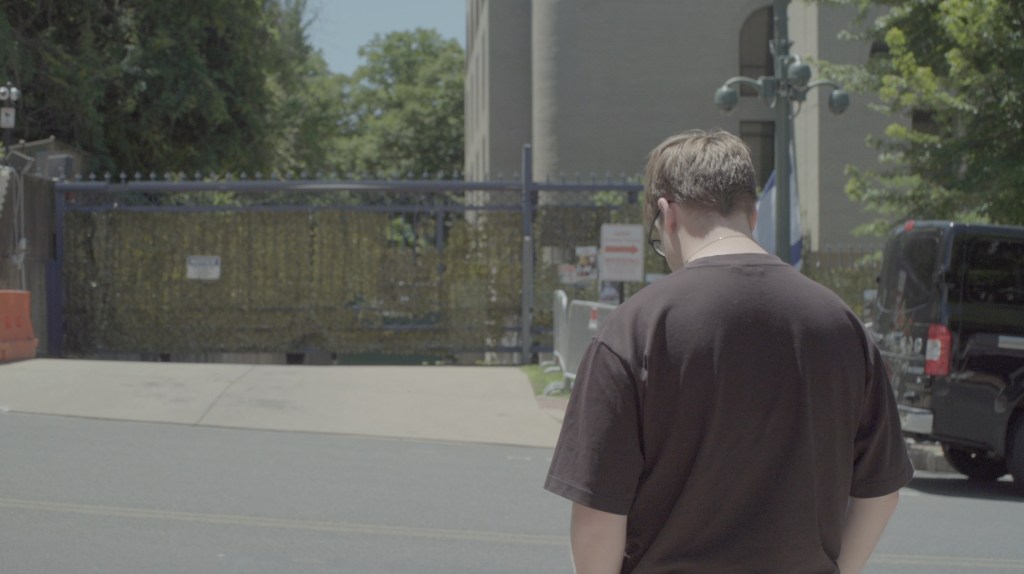
Outside the Israeli embassy in DC 
Fakhri Abu Diab explains how the occupation went about arresting him and demolishing his home 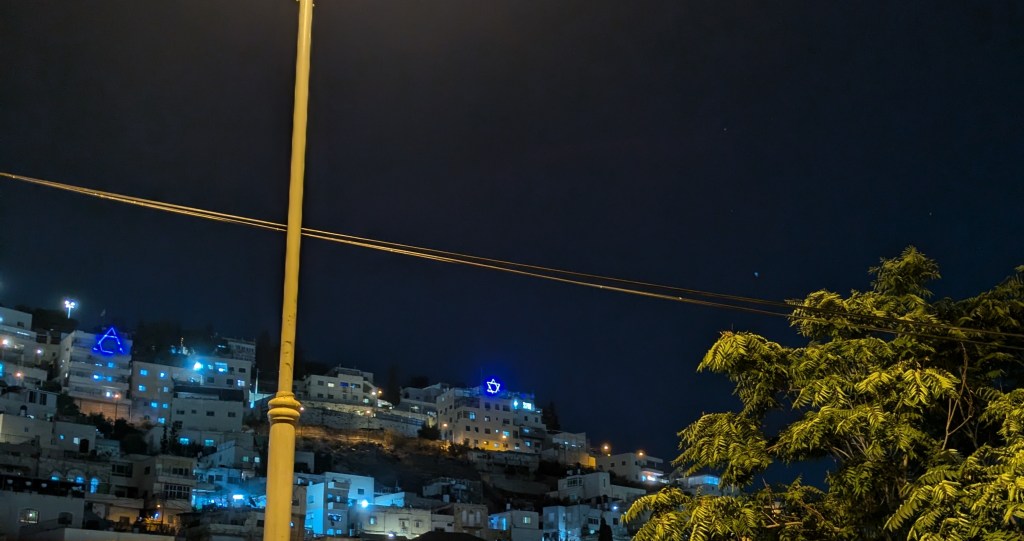
Overlooking a Palestinian family’s demolished home, neon Stars of David serve as symbols of settler encroachment 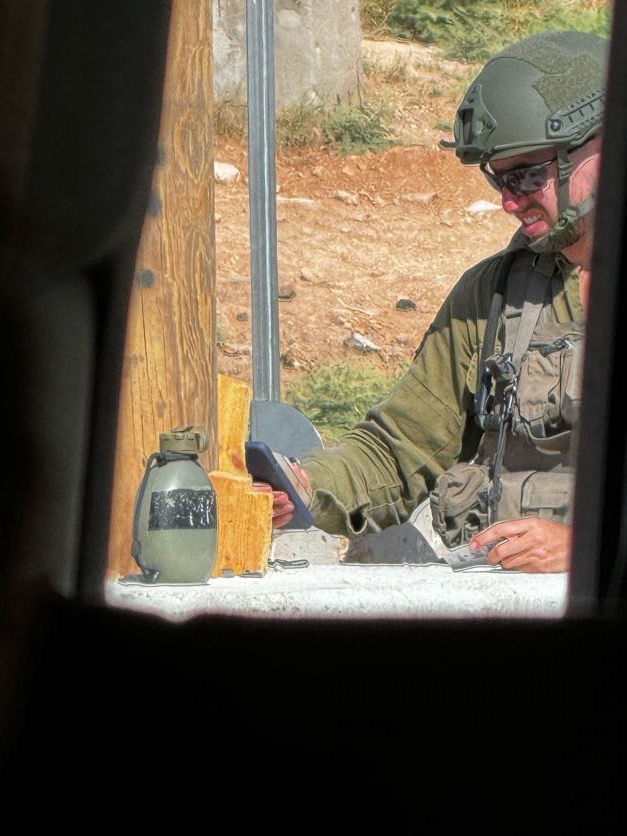
A member of the Israeli occupation forces appears to search our names (and later, take pictures of our passports) on his phone as we wait at a checkpoint 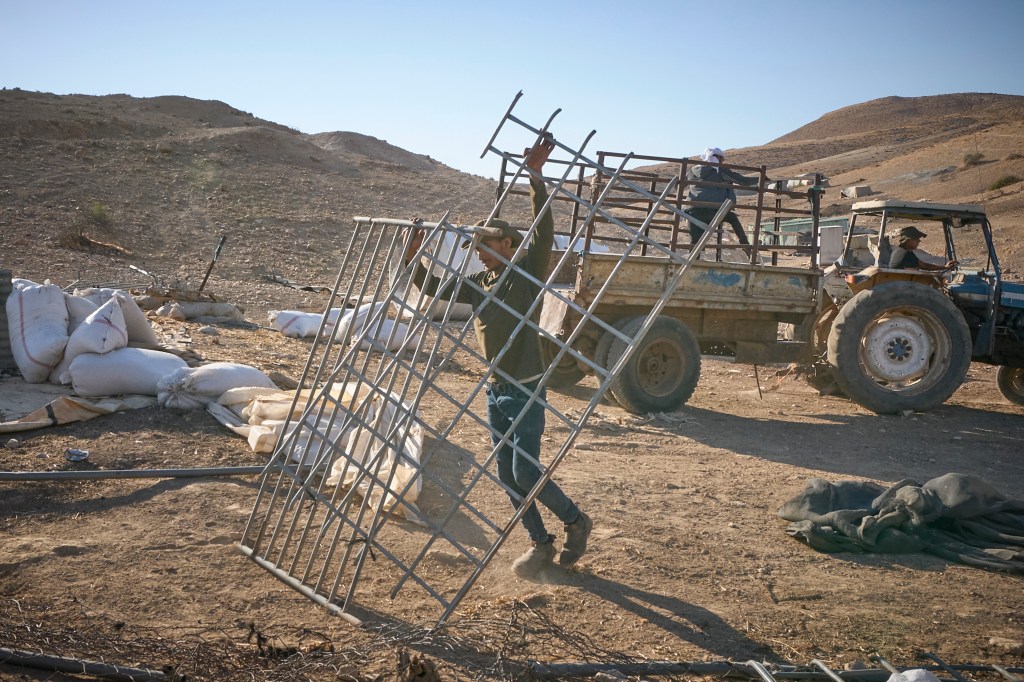
Bedouin villagers pack up equipment and belongings, preparing to move due to settler violence and harassment 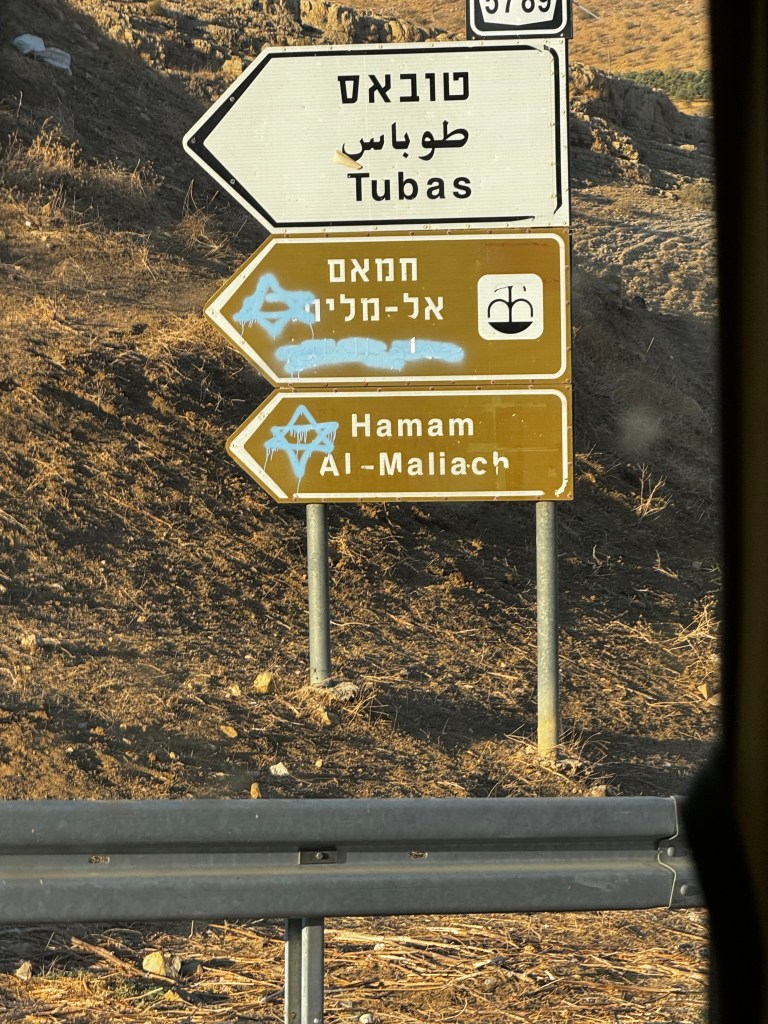
Graffiti over the Arabic on a street sign in the West Bank 
A vehicle used by the Israeli occupation, returning from Gaza 
Tanks sit outside the border of Gaza 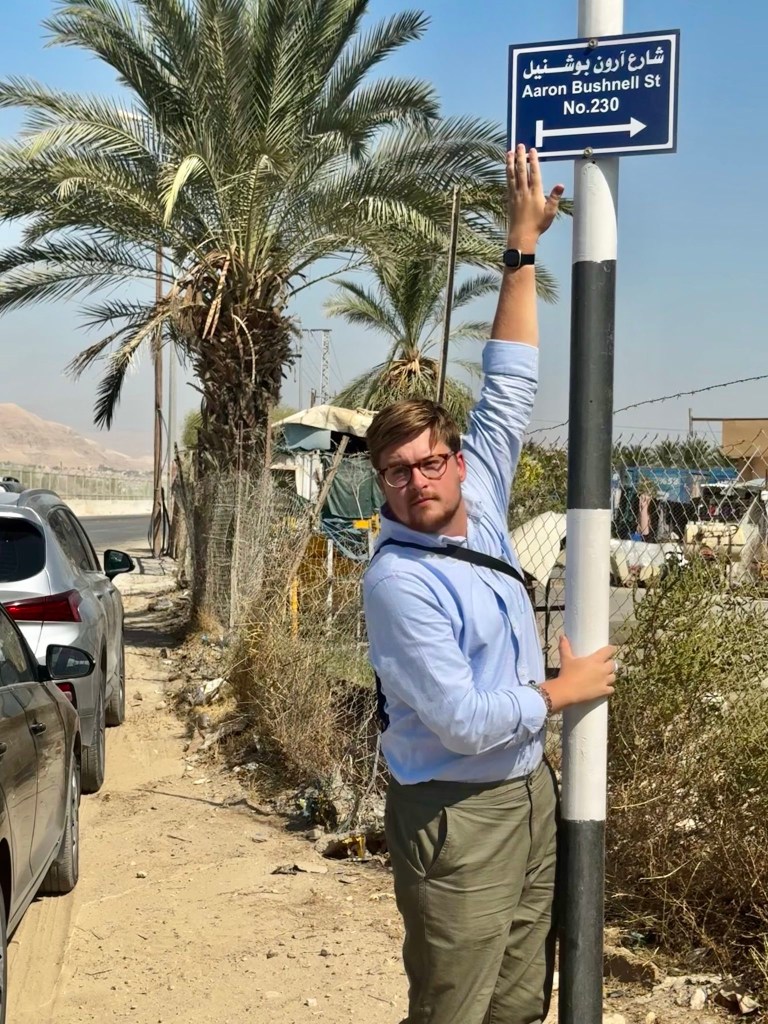
Jericho, Palestine
Note: the photos above taken in Palestine are a few of many, meant to provide additional context for the reflections on my trip there. Photos outside the Israeli embassy courtesy of Aisha Soofi.

 levipierpont.com